 Image 1 of 4
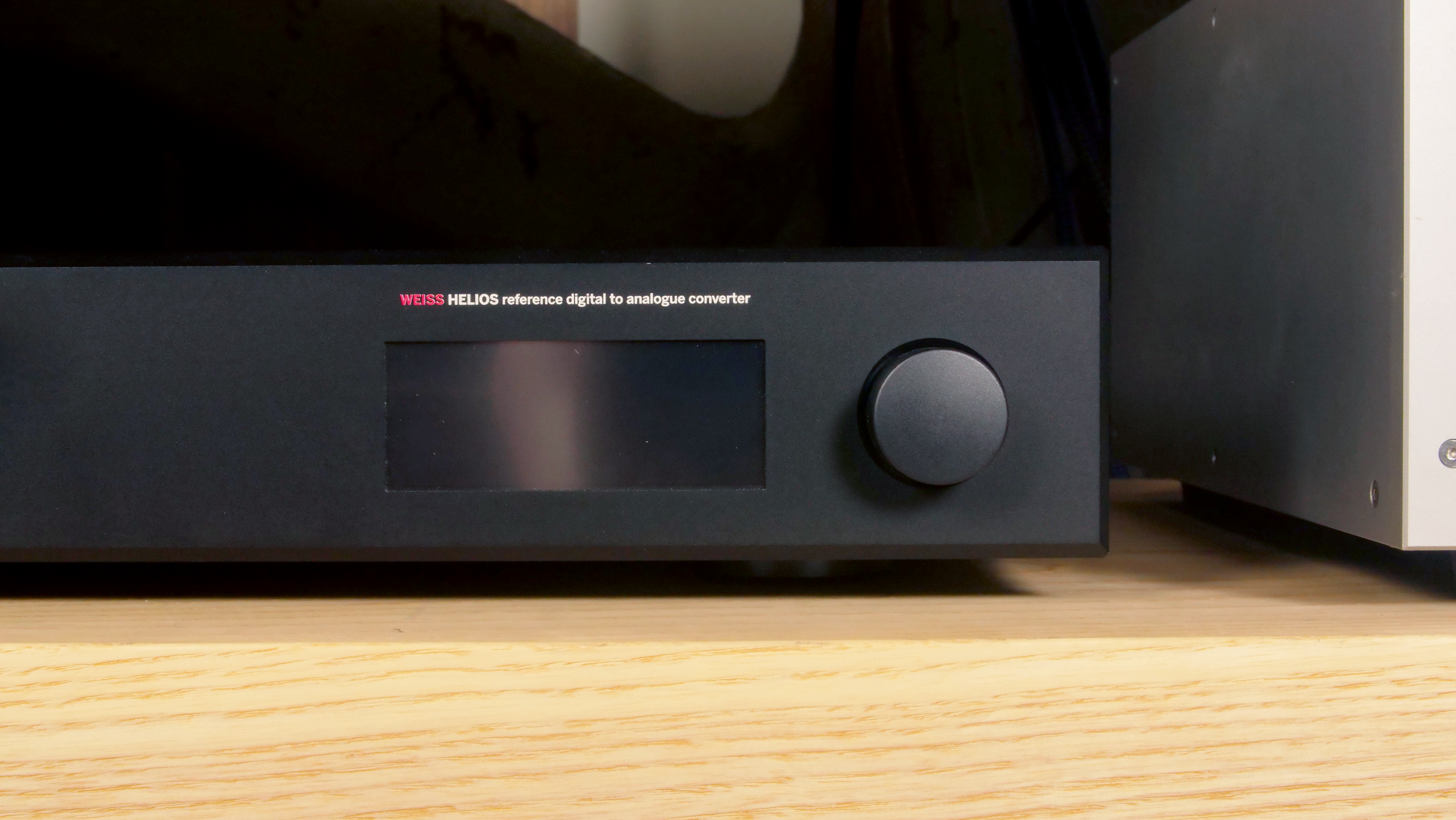 Image 2 of 4
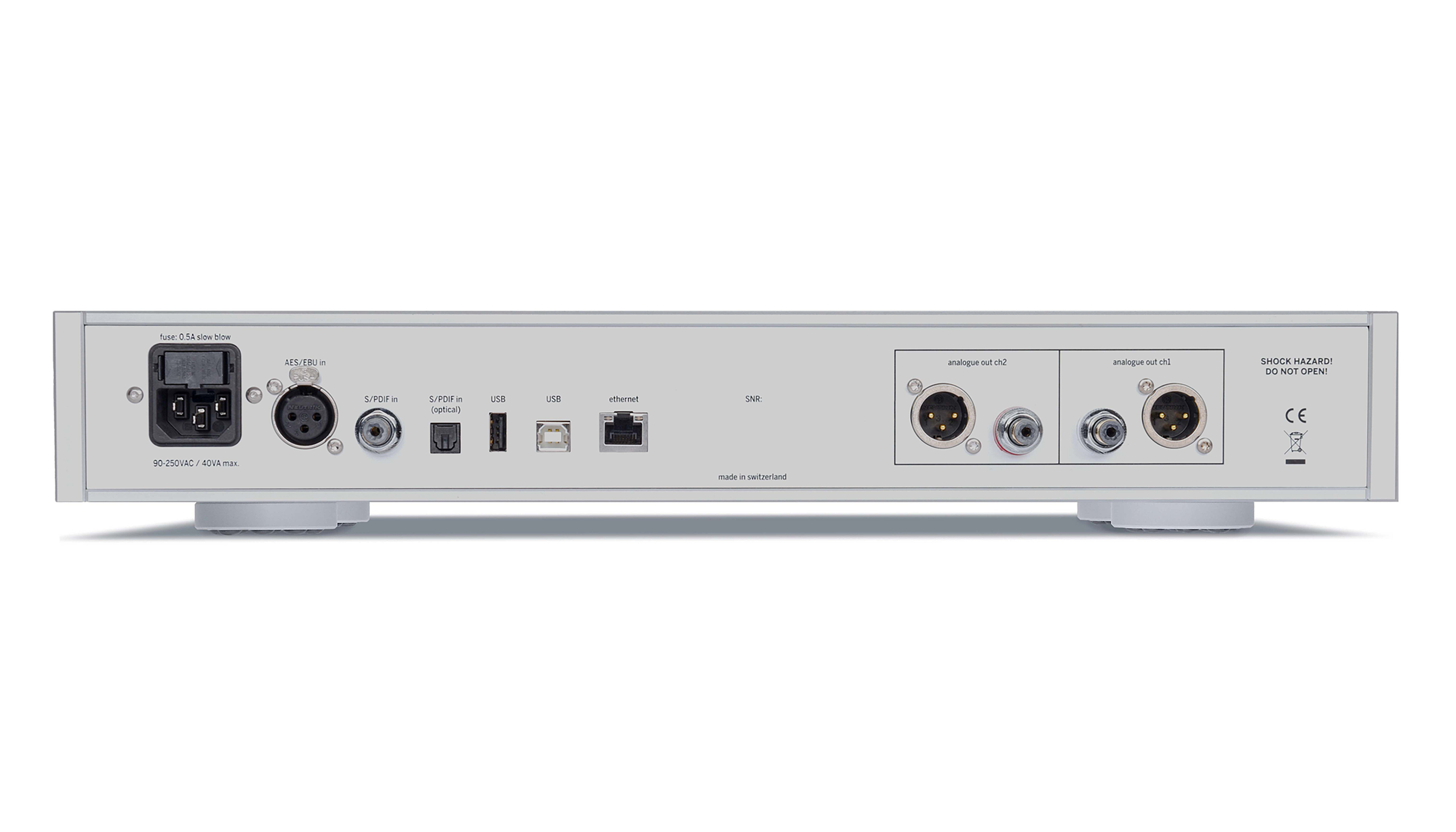 Image 3 of 4
 Image 4 of 4
Main Features
High Connectivity
The HELIOS comes with digital inputs in numerous formats and has both balanced and unbalanced analog outputs. All standard sampling frequencies up to 384 kHz plus DSD x64 and x128 are supported.
Furthermore, the unit functions as a preamp, headphone amp, and a streamer (UPnP/ROON).
The HELIOS also seamlessly integrates with the JPLAY iOS app – you can enjoy your favorite tracks from Qobuz, Tidal, and your local collection, all in one unified library.
Professional Level at Home
Weiss Engineering’s professional clients work in the world’s top-tier studios, fine-tuning the sound of the biggest artists on the planet. It is not an option for them to use anything but the best monitoring chains in existence. This is why they use Weiss Engineering’s professional DACs.
The HELIOS maintains that same quality level, with design and features that better suit the high-end hi-fi market. With the HELIOS, you are hearing what the professionals are hearing.
Purist Signal Path
To achieve its exceptional performance specifications, the HELIOS uses an eight-channel 32-bit D/A converter chip, with four paralleled conversion channels per audio channel. All analog processing is done with our own discrete operational amplifier modules, the Weiss OP2-BP — arguably the best audio operational amplifier currently available.
It also uses an internal high-precision/low jitter clock generator for ultra-stable clocking of the D/A converter section.
Weiss DAC Comparison
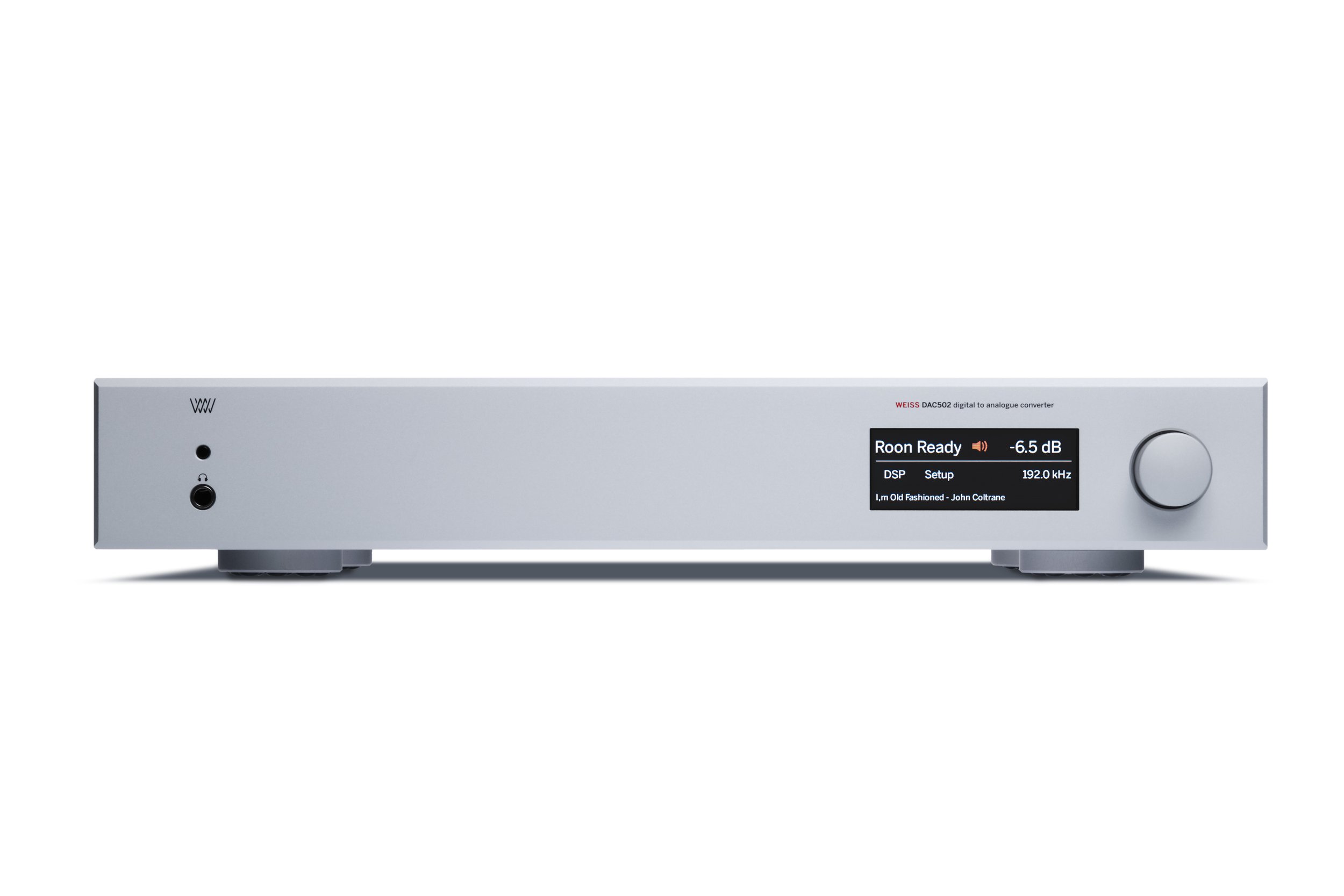
The HELIOS and its siblings DAC501 and DAC502 are based on the same digital audio platform, but the HELIOS sports a different D/A Converter and analog output section.
The HELIOS’ XLR and RCA outputs can be used to drive amplifier line inputs as well as headphones directly or via a dedicated headphone amplifier.
The DSP processing can be switched to speaker or headphone mode as required.
The HELIOS housing is made of a dual frame scheme with a stainless steel internal frame and a thick aluminum outer frame.
Ease of Use
The HELIOS comes with an IR remote control which can be used to select the active input and output, the DSP audio processing presets, and switch power on and off.
Furthermore, it is possible to control and configure the HELIOS via a web browser, which adds detailed control of the DSP processing and preset management.
Professional Processing
The built-in digital audio processing is based on the same trailblazing algorithms that are used in Weiss Engineering’s professional audio tools.
So with the HELIOS you can adjust the audio using the same professional-grade algorithms that were used to mix and master the original recordings.
Technical Data
-
There are a total of five inputs:
AES/EBU or S/PDIF via XLR, Toslink and RCA sockets.
UPnP/DLNA via Ethernet.
USB.
Roon Ready.
Accepted formats: PCM 44.1kHz up to 384 kHz, DSD 64x / 128x.
Future formats can be accommodated via software updates.
- Maximum input word-length: 24 Bits
-
Outputs
Line / Headphone out unbalanced on RCA connector.
Line / Headphone out balanced on XLR connector.
Output stages based on our discrete OP2-BP Operational Amplifier design are employed.
The output levels can be set in a coarse manner with eight steps to adapt for the amplifier or headphone connected.
The levels can be set independently for line and headphone outputs.
No sound degrading servo mechanisms are used.
-
The HELIOS uses a built-in digital signal processing (DSP) chip for its audio processing. These algorithms are included:
Room Equalizer – to suppress room modes for more accurate bass reproduction.
Creative Equalizer – a tone control with low boost/cut, high boost/cut, and mid boost/cut. Very useful to correct those recordings which do not quite sound right.
De-Essing – the automatic removal of overly bright sibilances from human voices. The sibilance effect can be more or less pronounced depending on your speakers or room acoustics.
Constant Volume – adjusts the audio volume (loudness) to a constant value across all tracks played. Useful for “party mode” when the volume control should stay untouched.
Vinyl Emulation – get that special sonic character of a record player based playback chain. We also employ an emulation of the DMM-CD procedure offered by the Stockfisch label.
Crosstalk Cancelling (XTC) – for the playback of dummy head recordings or live recordings via speakers for an incredible live sensation. Dummy head recordings usually are listened to via headphones because they only work properly if the left channel goes to the left ear only and the right channel to the right ear only. With speakers this is difficult to achive as the left channel goes to the left and the right ear. But with some clever signal processing of the speaker channels is is possible to suppress the crosstalk, i.e. the audio going from the left speaker to the right ear and vice versa. If that works properly then the recording sounds as if one would be in the space where the recording has taken place. All the reverberation and 3D representation of the sound sources is there.(For speaker based playback only.)
Loudness Control – a listening volume dependent equalization of the audio.
Headphone Equalizer – to adapt any headphone to the listener’s ears in terms of frequency response.
Crossfeed – to emulate a speaker based playback impression on headphones.
-
A rotary encoder knob for changing parameters and for powering the unit on/off.
A touch screen colour LCD display.
An IR receiver.
-
Analog outputs on XLR and RCA connectors.
Digital inputs on XLR, RCA, TOSLINK, USB, and Ethernet connectors.
USB type-A connector for various applications.
Mains connector with fuses.
-
HELIOS
Depth: 30 cm / 11.8 inches
Width: 45 cm / 17.7 inches
Height: 6.6 cm / 2.6 inches
Height with feet: 7.4 cm / 2.9 inchesIR Remote Control
Depth: 2.1 cm / 0.83 inches
Width: 4.5 cm / 1.78 inches
Height: 16.6 cm / 6.53 inches -
A powerful non-switching power supply is used. All sensitive voltages have their own regulators which are separated between left and right channels. The result is an analog output free of “digital noise” and channel crosstalk.
The power switch activates a semiconductor relay which only switches on or off at zero crossings of the mains voltage. This assures a glitch-free power switching. The two mains transformers are toroidal types.
Mains voltage selection is done automatically by measuring the mains voltage before power is applied to the rest of the electronics.
Reviewers
-
Read the entire article here.
Digital Processor A+ Class
“The Roon Ready Helios superficially looks identical to the DAC502 that JA reviewed in August 2022, but it uses a new output stage that can drive headphones directly (headphone adapter cables cost $495). While the Helios uses the same ESS Sabre ES9038PRO HyperStream II DAC chip, four of the DAC channels are operated in parallel for each analog output compared with the DAC502's two. The Helios offers the same DSP functions as the earlier processor—Room EQ, Creative (parametric) EQ, DeEsser, Dynamic Adaptation, Vinyl Emulation, and Crosstalk Cancellation—and there are now a large number of equalization presets available for headphones. In the test lab, the Weiss Helios featured a resolution between 21 and 22 bits, which is the highest JA had encountered, greater even than that of the DAC502. The Helios also offered very low levels of harmonic and intermodulation distortion and excellent rejection of word-clock jitter. JA wrote of the DAC502 that it retrieved more information from the digits than any other DAC he had auditioned. With both loudspeakers and headphones, he found that the Helios echoed the DAC502's extraordinary clarity, "but with an enhanced sense of involvement with the music." JA concluded that three decades ago, choosing a product that favored "accuracy" or "musicality" may have been necessary, but today that isn't the case. "The Weiss Helios shows you can have both." (Vol.47 No.3 WWW)”
-
Read the entire review here.
-
Read the entire review here.